Operating Margin: Formula, Examples & How to Improve It
Learn how to calculate operating margin, interpret the result, compare it with other profit margins, and improve operating efficiency with practical examples.
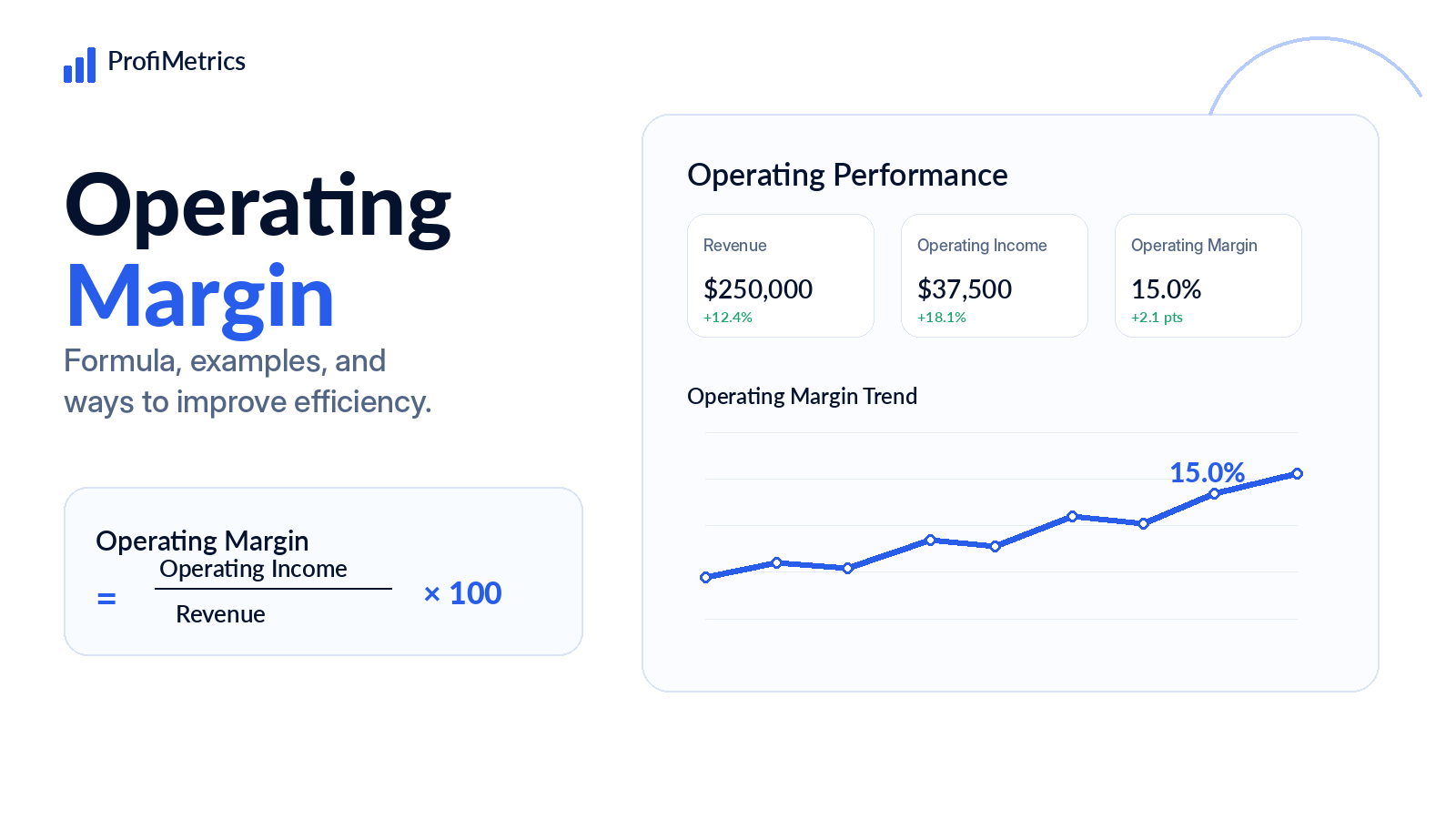
Operating margin shows how much of a company's revenue remains after paying the costs required to run the core business. It is one of the clearest ways to evaluate operating efficiency because it connects sales, cost structure, pricing, and day-to-day execution in a single percentage.
The basic formula is:
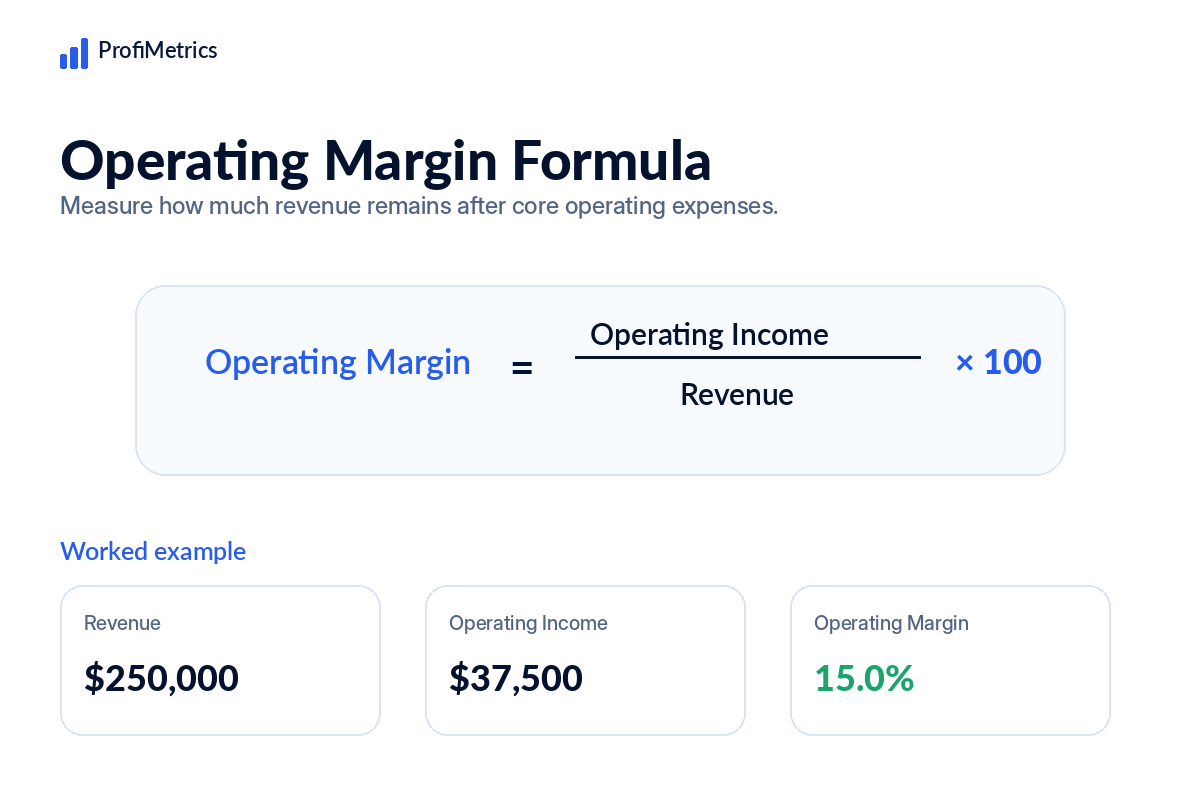
If a business produces $250,000 in revenue and $37,500 in operating income, its operating margin is 15%.
That means the company retains 15 cents of operating profit from every dollar of revenue before interest and taxes.
If you already know your revenue and operating income, use the free ProfiMetrics Operating Margin Calculator to calculate the percentage instantly.
What Is Operating Margin?
Operating margin measures the profitability of a company's core operations.
It answers a practical question:
After the normal costs of running the business, how much operating profit is left from each dollar of revenue?
Operating margin sits between gross margin and net profit margin in the income statement.
Gross margin focuses on revenue minus the direct cost of producing a product or delivering a service. Operating margin goes further by also considering operating expenses such as salaries, rent, software, sales and marketing expenses, and administrative overhead.
Net margin goes one step further and includes additional items such as interest, taxes, and certain non-operating gains or losses.
Because operating margin excludes financing and tax structure, it is especially useful when you want to evaluate how efficiently the underlying business itself is performing.
Operating Margin Formula
The operating margin formula is:
Operating income is generally calculated as:
Depending on the company's accounting presentation, operating income may also be called operating profit or EBIT when there are no material differences between the two.
Operating margin example
Suppose a company reports:
- Revenue: $250,000
- Cost of goods sold: $120,000
- Operating expenses: $92,500
First calculate operating income:
Then calculate operating margin:
The company's operating margin is therefore 15%.
For every $1.00 in revenue, the business generates approximately $0.15 in operating profit before interest and taxes.
How to Calculate Operating Margin Step by Step
1. Choose the reporting period
Start with a consistent reporting period such as a month, quarter, or year.
Both revenue and operating income must come from the same period. Comparing monthly operating income with annual revenue would create a meaningless result.
For management analysis, monthly or quarterly operating margin can reveal changes faster. For long-term comparisons, annual figures are often easier to interpret.
2. Determine total revenue
Use the revenue figure from the income statement for the selected period.
Revenue should reflect the accounting rules used consistently by your business. If returns, discounts, or allowances are deducted before net revenue is reported, use that same definition whenever you compare operating margin over time.
3. Calculate operating income
Operating income is the profit produced by the core business after direct costs and operating expenses.
Typical operating expenses can include:
- payroll and employee benefits,
- rent and facilities,
- software subscriptions,
- sales and marketing,
- administrative expenses,
- professional services,
- depreciation associated with operations,
- customer support,
- fulfillment overhead.
Interest expense and income taxes are normally excluded because they are not part of operating performance.
4. Divide operating income by revenue
Once both figures are consistent:
5. Convert the result to a percentage
Multiply the decimal result by 100.
For example:
You can also enter the values in the Operating Margin Calculator to calculate the percentage directly.
Why Operating Margin Matters
Revenue growth can look impressive while hiding deteriorating economics.
A company can increase sales by 30% and still become less attractive if operating expenses grow even faster. Operating margin helps expose that problem.
Consider two businesses:
| Company | Revenue | Operating Income | Operating Margin |
|---|---|---|---|
| Company A | $1,000,000 | $180,000 | 18% |
| Company B | $1,400,000 | $140,000 | 10% |
Company B generates more revenue, but Company A converts a much larger percentage of revenue into operating profit.
That does not automatically make Company A the better business. Growth rate, market position, customer retention, reinvestment strategy, and capital requirements also matter. But operating margin gives you a clearer view of the economic efficiency behind the revenue number.
It can help management answer questions such as:
- Are operating expenses growing faster than sales?
- Is pricing keeping pace with labor and supplier costs?
- Are new customers generating enough profit to justify acquisition spending?
- Is the company becoming more efficient as it scales?
- Which products, locations, or business units support the strongest margins?
Operating Margin vs. Gross Margin
Operating margin and gross margin are related but measure different layers of profitability.
Gross margin subtracts the direct cost of producing the goods or services sold.
Operating margin also incorporates operating expenses required to run the business.
A company might have a 60% gross margin but only a 12% operating margin if sales, marketing, payroll, rent, software, and administrative expenses consume a large part of gross profit.
You can use the ProfiMetrics Gross Margin Calculator when you want to analyze production or service-delivery economics before operating overhead.
A simplified income statement might look like this:
| Item | Amount |
|---|---|
| Revenue | $500,000 |
| Cost of Goods Sold | $200,000 |
| Gross Profit | $300,000 |
| Gross Margin | 60% |
| Operating Expenses | $225,000 |
| Operating Income | $75,000 |
| Operating Margin | 15% |
The difference between the 60% gross margin and 15% operating margin shows how much of gross profit is being used to operate the business.
Operating Margin vs. Net Profit Margin
Net profit margin includes more items than operating margin.
Operating margin focuses on core operating performance.
Net profit margin also reflects:
- interest expense,
- interest income,
- taxes,
- certain non-operating gains,
- certain non-operating losses.
This distinction can be useful when comparing companies with different financing structures.
For example, two businesses may have almost identical operating margins, but one carries much more debt. The heavily indebted company could report a significantly lower net margin because of interest expense.
Operating margin tells you how the business performs operationally. Net margin tells you what ultimately remains for owners after all expenses.
Operating Margin vs. Contribution Margin
Contribution margin is usually more useful for decisions at the unit, product, or customer level.
It subtracts variable costs from revenue and shows how much remains to cover fixed costs and profit.
Operating margin considers a broader set of operating expenses and reflects company-level profitability.
For example, a product might have an excellent contribution margin but still belong to a company with a weak operating margin because corporate overhead is too high.
For unit-level economics, use the Contribution Margin Calculator. For overall operating efficiency, operating margin is the more appropriate metric.
What Is a Good Operating Margin?
There is no single operating margin that is good for every business.
A healthy margin depends heavily on:
- industry,
- business model,
- company maturity,
- capital intensity,
- geographic market,
- pricing power,
- labor requirements,
- growth strategy.
A software company and a grocery retailer can both be strong businesses while operating at very different margin levels.
For this reason, generic benchmarks should be treated carefully.
A more useful approach is to compare:
- Your margin over time. Is operating margin improving, stable, or declining?
- Similar companies. Compare against businesses with comparable economics.
- Your internal targets. Is the company producing the operating leverage expected from its plan?
- Margin and growth together. A temporary margin decline may be acceptable if it is caused by deliberate investments that produce durable growth.
A 12% margin that is steadily improving may be more attractive than a 20% margin that is falling quickly.
How to Improve Operating Margin
Improving operating margin usually requires increasing operating income faster than revenue—or reducing costs without damaging the company's ability to generate revenue.
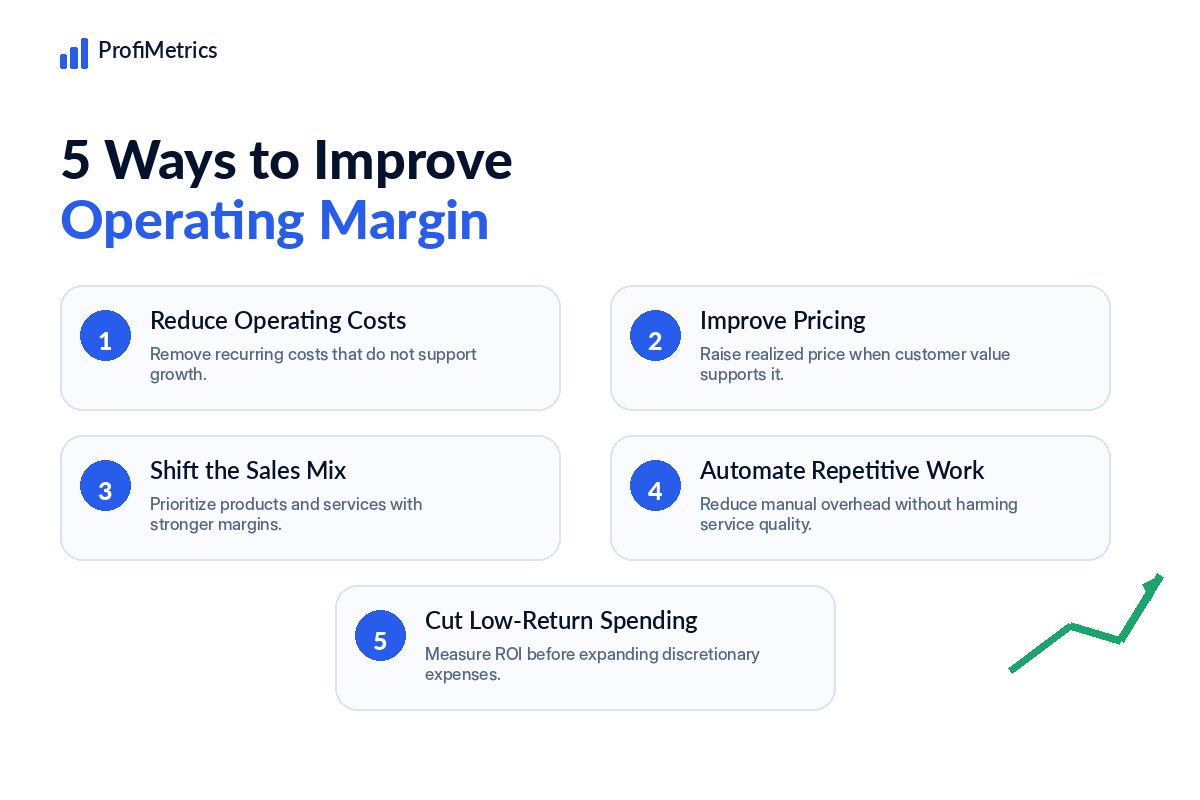
1. Reduce operating costs strategically
Cost reduction should focus on expenses that do not meaningfully support revenue, product quality, customer experience, or long-term capabilities.
Examples may include:
- duplicate software subscriptions,
- underused tools,
- inefficient vendor contracts,
- unnecessary office expenses,
- manual processes that can be simplified,
- services with unclear business value.
The objective is not simply to spend less. It is to spend more efficiently.
Across-the-board cuts can improve margin temporarily while damaging customer service, employee productivity, or future growth.
2. Improve pricing
Small improvements in realized price can have a significant effect on operating margin when variable costs do not increase proportionally.
Pricing improvement can come from:
- reducing unnecessary discounting,
- introducing premium tiers,
- improving packaging,
- charging for high-value add-ons,
- increasing prices where customer value supports it,
- improving price discipline across sales channels.
Before increasing prices, understand customer sensitivity, competitive alternatives, and the value the product delivers.
3. Shift sales toward higher-margin products or services
Revenue mix matters.
A business may sell multiple products that generate very different levels of operating profit.
Management can analyze:
- gross margin by product,
- contribution margin by product,
- support burden,
- fulfillment requirements,
- sales effort,
- return rates,
- recurring revenue potential.
Increasing the percentage of sales coming from stronger-margin offerings can improve company-level operating margin even when total revenue grows at the same rate.
4. Automate repetitive work
Automation can reduce the amount of manual work required to support each dollar of revenue.
Opportunities often exist in:
- reporting,
- invoicing,
- customer onboarding,
- lead routing,
- data entry,
- inventory updates,
- scheduling,
- customer support triage,
- recurring administrative workflows.
Automation should be evaluated based on the full economics. A tool that saves only a few minutes per month may not justify its subscription cost, while automation of a high-volume workflow can produce meaningful operating leverage.
5. Eliminate low-return spending
Every operating expense should have a reason to exist.
Marketing campaigns, software tools, contractors, events, subscriptions, and internal initiatives should be evaluated against measurable outcomes whenever possible.
This does not mean that every expense must produce immediate revenue. Brand, research, infrastructure, and employee development can create long-term value.
The key is knowing why the expense exists and whether the expected return still justifies it.
Operating Leverage and Margin Expansion
Operating margin often improves as a business scales because certain expenses do not increase at the same rate as revenue.
Suppose a company grows revenue from $1 million to $1.4 million while its fixed administrative costs remain close to $200,000.
If gross profit also increases, more of the incremental revenue can flow into operating income.
This effect is called operating leverage.
However, operating leverage can work in both directions. When revenue declines, fixed operating costs can cause operating margin to contract rapidly.
That is why companies with large fixed-cost structures need to understand the relationship between revenue volume and operating expenses.
Common Operating Margin Mistakes
Mixing operating and non-operating expenses
Interest and taxes normally belong outside operating income.
Including them can turn operating margin into something closer to net margin.
Comparing different accounting definitions
One company may classify certain costs in cost of goods sold while another classifies similar costs in operating expenses.
When comparing companies, read the underlying financial statements instead of relying only on the percentage.
Optimizing margin while ignoring growth
A company can increase margin by cutting almost every growth investment.
That can look good temporarily but weaken future revenue.
Margin should be evaluated together with growth, retention, product quality, and customer economics.
Ignoring one-time expenses
A restructuring charge or unusual legal expense can distort a single period.
When analyzing trends, understand whether the period reflects normal operations.
Treating every industry the same
Operating margin varies significantly across business models.
A direct comparison between unrelated industries is rarely useful.
How to Analyze Operating Margin Over Time
A single margin percentage provides a snapshot. The trend usually provides more insight.
Track operating margin monthly or quarterly and examine the reasons behind important changes.
For example:
| Quarter | Revenue | Operating Income | Operating Margin |
|---|---|---|---|
| Q1 | $500,000 | $50,000 | 10% |
| Q2 | $560,000 | $67,200 | 12% |
| Q3 | $620,000 | $86,800 | 14% |
In this example, revenue rises 24% from Q1 to Q3 while operating income rises more than 73%.
That is a strong sign of operating leverage: the company is converting additional revenue into operating profit more efficiently.
But if revenue grows while operating margin falls, investigate whether:
- labor expenses increased,
- marketing efficiency declined,
- discounting increased,
- software or infrastructure costs expanded,
- the product mix shifted,
- customer support became more expensive,
- management deliberately invested ahead of future growth.
The percentage tells you what changed. The income statement helps explain why.
Frequently Asked Questions
Is operating margin the same as EBIT margin?
Often they are used interchangeably, particularly when operating income and EBIT are calculated the same way. However, accounting presentations can differ, so confirm the components included in each figure before assuming they are identical.
Can operating margin be negative?
Yes. A negative operating margin means core operating expenses exceeded gross profit during the period. Early-stage businesses can operate with negative margins while investing in growth, but persistent negative operating margin eventually requires additional capital or significant improvement.
Is a higher operating margin always better?
All else equal, a higher operating margin indicates stronger operating profitability. But margin should not be optimized in isolation. A company can increase margin by cutting investments that are essential to long-term growth.
How often should operating margin be calculated?
For active business management, monthly or quarterly tracking is often useful. Annual calculations are better for longer-term comparisons but can hide changes that occurred during the year.
What causes operating margin to decline?
Common causes include lower pricing, increased discounts, rising wages, higher marketing expense, unfavorable product mix, supplier cost increases, inefficient overhead, and investments made ahead of revenue growth.
Calculate Your Operating Margin
Operating margin turns the income statement into a simple measure of operating efficiency.
The formula is:
Use it to understand how efficiently your business converts revenue into operating profit, monitor the effect of cost and pricing decisions, and identify whether scaling is producing stronger economics.
For an instant calculation, enter your revenue and operating income in the free ProfiMetrics Operating Margin Calculator.
Then compare the result with related profitability metrics such as Gross Margin and Contribution Margin to understand where profit is being created—or lost—throughout the business.