Contribution Margin Formula: Calculate It, Understand It & Use It to Make Better Business Decisions
Contribution margin tells you how much revenue remains after paying the costs that change with sales or production. That remaining amount is what your business has available to cover fixed costs and, after those fixed costs are covered, generate profit.
The basic formula is:Contribution Margin = Revenue − Variable Costs
For a single product or service:Contribution Margin per Unit = Selling Price per Unit − Variable Cost per Unit
And to express contribution margin as a percentage of sales:Contribution Margin Ratio = Contribution Margin ÷ Revenue × 100
What Is Contribution Margin?
Contribution margin (CM) measures the portion of sales revenue left after variable costs are deducted. Variable costs rise or fall as sales or production changes. Typical examples can include direct materials, packaging, shipping per unit, sales commissions, and payment-processing fees when those costs vary with each sale.
Fixed costs are different. Expenses such as rent, many salaried administrative roles, and some software subscriptions may remain relatively constant within a normal operating range.
This distinction is what makes contribution margin useful: it shows how much each sale contributes toward paying fixed costs and ultimately producing operating profit.
The Contribution Margin Formula
There are three closely related calculations.
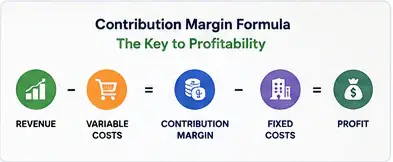
Total contribution margin
If a business generates $100,000 in monthly revenue and incurs $60,000 in variable costs:
$100,000 − $60,000 = $40,000 contribution margin
That $40,000 is available to cover fixed costs. If fixed costs are $30,000, the remaining $10,000 contributes to operating profit.
Contribution margin per unit
Suppose a product sells for $50 and costs $30 in variable costs to produce and sell:
$50 − $30 = $20 contribution margin per unit
Every additional unit sold contributes $20 toward fixed costs and profit, assuming the economics remain unchanged.
Contribution margin ratio
Using the same $50 product with a $20 contribution margin:
$20 ÷ $50 × 100 = 40%
A 40% contribution margin ratio means that 40 cents of every sales dollar remains after variable costs to cover fixed costs and profit.
What Costs Should You Treat as Variable?
Correctly classifying costs is one of the most important parts of the calculation.
Variable costs may include:
- Direct materials
- Direct labor when labor changes with production volume
- Packaging
- Shipping or fulfillment per order
- Sales commissions
- Transaction or payment-processing fees
- Usage-based services directly tied to sales or production
Do not automatically classify every operating expense as variable. A cost is variable because its total changes in relation to activity, not simply because its amount changes occasionally.
For example, monthly rent is normally fixed even if the landlord raises it next year. Conversely, a 3% payment-processing fee is variable because the total fee grows as sales grow.
Contribution Margin Example
Imagine a small company selling a specialty product.
| Item | Amount |
|---|---|
| Selling price per unit | $80 |
| Materials | $22 |
| Packaging | $4 |
| Shipping | $8 |
| Payment fee | $2 |
| Total variable cost per unit | $36 |
The contribution margin per unit is:
$80 − $36 = $44
The contribution margin ratio is:
$44 ÷ $80 × 100 = 55%
If the company sells 1,000 units, total contribution margin would be:
1,000 × $44 = $44,000
If monthly fixed costs are $30,000, those sales provide enough contribution margin to cover the fixed costs with $14,000 remaining before other relevant non-operating items and taxes.
Contribution Margin and Break-Even Analysis
Contribution margin is one of the key inputs in break-even analysis.
For a business selling one product, the basic break-even formula in units is:
Using the example above:
$30,000 ÷ $44 ≈ 682 units
The business therefore needs to sell about 682 units to cover its fixed and variable costs under these assumptions.
After the break-even point is reached, the contribution margin from additional units generally increases profit as long as fixed costs do not step up and the per-unit economics remain stable.
Contribution Margin vs. Gross Margin
Contribution margin and gross margin answer different questions.
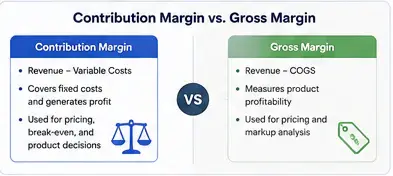
| Metric | Contribution Margin | Gross Margin |
|---|---|---|
| Basic calculation | Revenue − variable costs | Revenue − cost of goods sold |
| Main purpose | Understand how sales contribute to fixed costs and profit | Measure profitability after direct production/service costs |
| Cost classification | Focuses on cost behavior: variable vs. fixed | Focuses on accounting classification: COGS vs. operating expenses |
| Useful for | Pricing, break-even, product mix, short-term decisions | Financial reporting and product/service profitability |
A variable selling expense such as a sales commission may be included in contribution margin analysis even though it may not be part of cost of goods sold. That is one reason the two metrics should not be treated as interchangeable.
How to Use Contribution Margin in Business Decisions
1. Pricing decisions
A product with a weak contribution margin may leave too little revenue to cover fixed costs. Management can evaluate whether pricing should increase, variable costs should decrease, or the product needs to be repositioned.
2. Product mix
If capacity is limited, comparing contribution margins can help identify which products contribute more toward fixed costs and profit. The decision should still consider demand, strategic importance, capacity constraints, and other business factors.
3. Break-even planning
Contribution margin lets you estimate how many units or how much revenue you need before the business covers its costs.
4. Cost control
Breaking variable costs into components can reveal where margins are being compressed by materials, fulfillment, commissions, or transaction costs.
5. Scenario analysis
You can model questions such as:
- What happens if price increases by 5%?
- How much does margin improve if shipping costs fall?
- How many additional units are needed to cover a new fixed expense?
- What happens to break-even if variable cost per unit rises?
What Is a Good Contribution Margin?
There is no universal contribution margin percentage that is “good” for every business.
A software company, consulting practice, retailer, restaurant, and manufacturer can have very different cost structures. A useful contribution margin must be evaluated alongside fixed costs, pricing strategy, sales volume, capacity, and the economics of the specific industry.
Instead of chasing an arbitrary benchmark, ask:
- Is the contribution margin sufficient to cover fixed costs at realistic sales volume?
- Is it improving or deteriorating over time?
- Which products or services contribute the most?
- Can pricing or variable costs be improved without damaging demand or quality?
Common Contribution Margin Mistakes
Confusing contribution margin with profit. Contribution margin still has to cover fixed costs before it becomes operating profit.
Leaving out variable selling expenses. Costs such as commissions and transaction fees may vary directly with sales even when they are not manufacturing costs.
Treating fixed costs as variable. Contribution margin analysis depends on separating costs according to behavior.
Comparing businesses without context. A higher contribution margin ratio does not automatically mean a better business if fixed costs, capital requirements, or demand characteristics are dramatically different.
Ignoring changes in the cost structure. At higher volume, a business may need another facility, supervisor, vehicle, or software tier. Fixed costs can therefore increase in steps.
Frequently Asked Questions
What is the contribution margin formula?
The basic formula is Revenue − Variable Costs. For one unit, subtract variable cost per unit from selling price per unit.
What does contribution margin tell you?
It tells you how much sales revenue remains after variable costs to cover fixed costs and generate profit.
Is contribution margin the same as gross profit?
No. Gross profit subtracts cost of goods sold from revenue. Contribution margin subtracts variable costs based on how costs behave, which can include variable selling expenses outside COGS.
Can contribution margin be negative?
Yes. A negative contribution margin means variable costs exceed the revenue generated. Selling more under the same economics can increase losses rather than improve profitability.
How is contribution margin used in break-even analysis?
Divide fixed costs by contribution margin per unit to estimate break-even units. For break-even sales dollars, businesses commonly use the contribution margin ratio.
Calculate Your Contribution Margin
Understanding the formula is useful; applying it to your own numbers is better.
Use the ProfiMetrics Contribution Margin Calculator to enter revenue, variable costs, and related inputs and see your contribution margin without building the calculation manually.
Use the Contribution Margin Calculatorarrow_forwardSources and Further Reading
- Intuit Enterprise Suite — Contribution margin: How to calculate it & understand profit drivers
- AccountingCoach — What is contribution margin?
- AccountingCoach — Break-even Point
- Corporate Finance Institute — Contribution Analysis